컴파일러작성
어셈블리 언어를 기계어 hex 파일로 변환한다.
어셀블리 언어를 작성하고 이 코드를 기계어 코드로 변환과정을 수행한다.
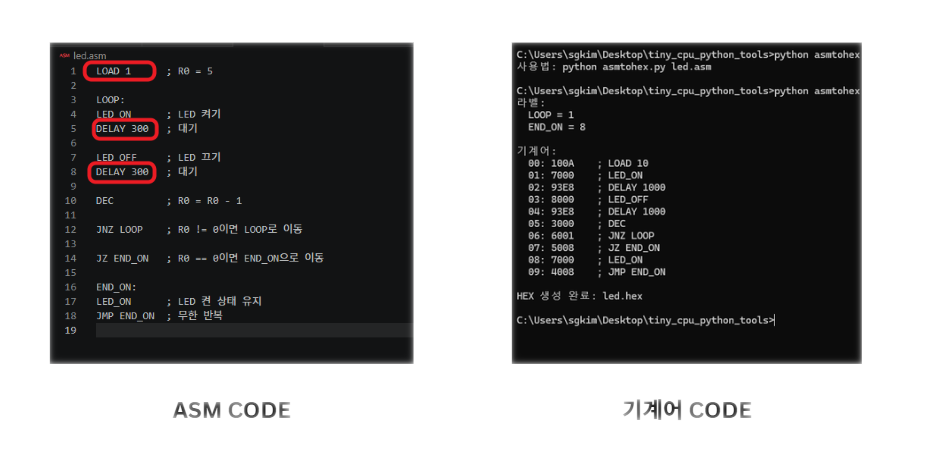
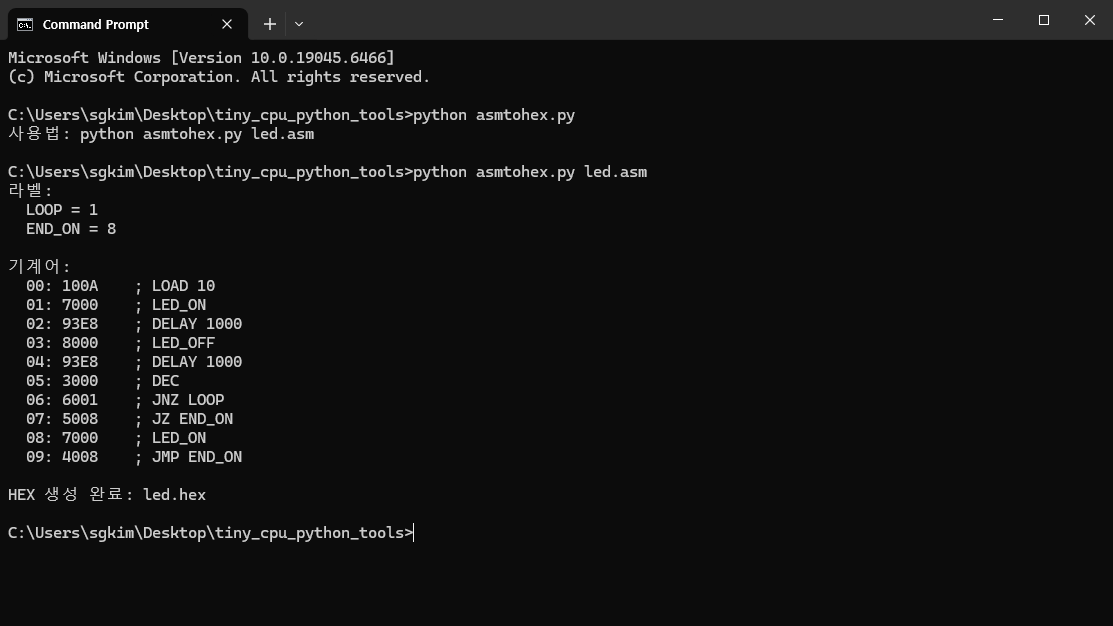
변환 프로그램 구동
python asmtohex.py led.asm
변환프로그램
asmtohex.py 파일 이름으로 다음과 파이썬 언어로 작성한다.
import sys
from pathlib import Path

OPCODE = {
    "NOP":     0x0,
    "LOAD":    0x1,
    "INC":     0x2,
    "DEC":     0x3,
    "JMP":     0x4,
    "JZ":      0x5,
    "JNZ":     0x6,
    "LED_ON":  0x7,
    "LED_OFF": 0x8,
    "DELAY":   0x9,
}

def remove_comment(line):
    return line.split(";")[0].strip()

def parse_number(text):
    text = text.strip()
    if text.lower().startswith("0x"):
        return int(text, 16)
    if text.lower().startswith("0b"):
        return int(text, 2)
    return int(text, 10)

def assemble(asm_text):
    labels = {}
    instructions = []
    pc = 0

    # 1차 패스: 라벨 주소 수집
    for raw_line in asm_text.splitlines():
        line = remove_comment(raw_line)

        if not line:
            continue

        if line.endswith(":"):
            label = line[:-1].strip()
            if label in labels:
                raise ValueError(f"중복 라벨: {label}")
            labels[label] = pc
            continue

        if ":" in line:
            label_part, inst_part = line.split(":", 1)
            label = label_part.strip()
            inst_line = inst_part.strip()

            if label in labels:
                raise ValueError(f"중복 라벨: {label}")

            labels[label] = pc

            if inst_line:
                instructions.append(inst_line)
                pc += 1

            continue

        instructions.append(line)
        pc += 1

    machine = []

    # 2차 패스: 명령어 변환
    for addr, line in enumerate(instructions):
        parts = line.replace(",", " ").split()

        if not parts:
            continue

        mnemonic = parts[0].upper()

        if mnemonic not in OPCODE:
            raise ValueError(f"{addr}: 알 수 없는 명령어: {mnemonic}")

        opcode = OPCODE[mnemonic]
        operand = 0

        if len(parts) >= 2:
            arg = parts[1]
            if arg in labels:
                operand = labels[arg]
            else:
                operand = parse_number(arg)

        if operand < 0 or operand > 0x0FFF:
            raise ValueError(f"{addr}: operand 범위 초과 0~4095: {operand}")

        word = (opcode << 12) | (operand & 0x0FFF)
        machine.append(word)

    return machine, labels, instructions

def main():
    if len(sys.argv) != 2:
        print("사용법: python asmtohex.py led.asm")
        sys.exit(1)

    asm_path = Path(sys.argv[1])

    if not asm_path.exists():
        print(f"파일 없음: {asm_path}")
        sys.exit(1)

    hex_path = asm_path.with_suffix(".hex")
    asm_text = asm_path.read_text(encoding="utf-8")

    machine, labels, instructions = assemble(asm_text)

    with hex_path.open("w", encoding="utf-8") as f:
        for word in machine:
            f.write(f"{word:04X}\n")

    print("라벨:")
    for name, addr in labels.items():
        print(f"  {name} = {addr}")

    print()
    print("기계어:")
    for addr, word in enumerate(machine):
        print(f"  {addr:02d}: {word:04X}    ; {instructions[addr]}")

    print()
    print(f"HEX 생성 완료: {hex_path}")

if __name__ == "__main__":
    main()